Deng Chaowei — Jersey Shop + FlashTrack
A custom football-shirt shop where you just describe the shirt you want in one sentence — "the white Spain shirt with my name and number 7" — and it understands you and fills in the whole order. Paired with FlashTrack, the tool that follows each order from the factory to your door.
One sentence in. A finished order out.
You type what you want the way you'd say it out loud. The shop reads that sentence and fills in the order — team, colour, year, name, number, size, cut — without you ever touching a single dropdown. The clever part isn't that it understands you. It's that it refuses to guess.
You type
“white Spain 2026 fan size M number 7 Manolo”
team
Spain
colour
white
year
2026
type
national
name
Manolo
number
7
size
M
cut
fan
The kind of sleeve and whether it's the home or away shirt aren't guessed either — they're only filled in when the team and colour make it certain. Anything you didn't say stays empty until you say it.
How it works
- 1You write one line, in Spanish or English.
- 2The shop first checks whether you're even describing a shirt — if not, it doesn't waste a second on it.
- 3It reads your sentence into a tidy order, and it's built to leave anything you didn't say blank rather than invent it.
- 4It matches what it understood against the real catalogue and fills your basket; you confirm or tweak it with a single tap.
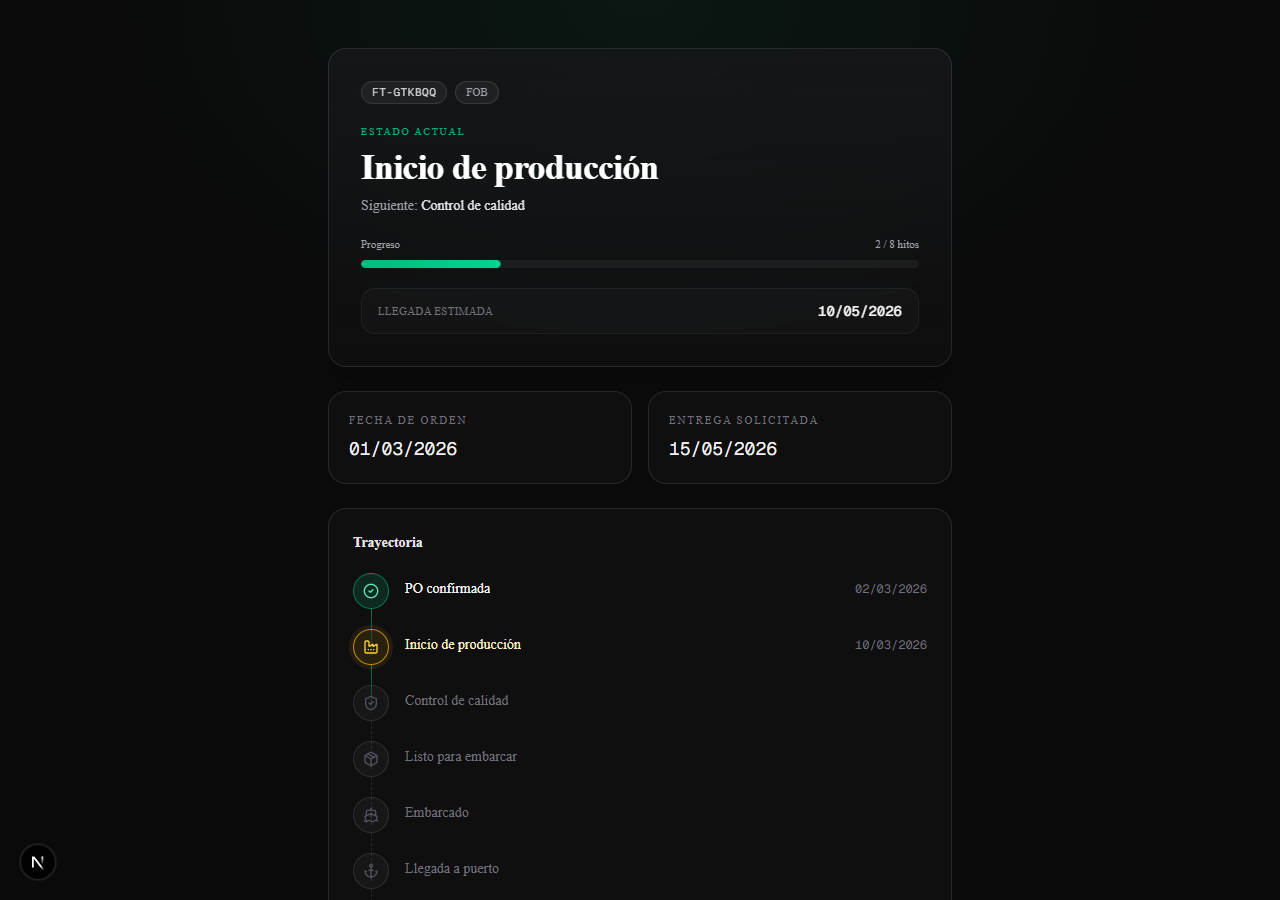
FlashTrack — the tracker the shop grew out of
Before the shop there was FlashTrack: a tool for following each order for the same supplier, from the moment it's confirmed through production, quality checks, shipping and customs. It pulls in updates from the couriers automatically and gives the customer a clean tracking page they can open with no account and no password. Everything it learned about following an order became the foundation the shirt shop is built on.
- Follows every order automatically
- Updates straight from the couriers
- One clean page, no login
- Built to be reused by the shop
The problem
Deng Chaowei sells custom football shirts — pick a team, a year, a name, a number, a fan or player cut, a size, home or away. That is a lot of small, exact choices, and someone who just wants "the white Spain shirt with my name on it" shouldn't have to learn the shop's jargon to order it.
What made it hard
- · Buyers describe shirts in their own words, in Spanish or English, and expect the shop to just understand.
- · The shop must never make up a detail the buyer didn't say — a wrong size or number is a real parcel that gets sent back.
- · It had to stay cheap to run, and keep working as an ordinary search box even when the clever part is switched off.
What I built
- · A single box where you describe the shirt you want, in a sentence.
- · A layer of intelligence that reads that sentence and fills in the order — team, colour, year, name, number, size, cut — then checks every detail against the real catalogue before showing it back to you.
- · Strict guardrails: it only calls on the clever part when your words actually describe a shirt, it limits how often anyone can use it, and it throws away anything the intelligence tries to invent.
- · If the clever part is ever unavailable, the shop quietly falls back to an ordinary search, so it never dead-ends.
How it turned out
The understanding part is fully built and tested, ready to switch on. The shop itself isn't open yet — checkout still runs in a safe practice mode with no real payments, and it isn't public. So rather than fake a live storefront, this page shows the real system from the inside, and the order-tracking tool it grew out of.
What I learned
- · Forcing the intelligence to leave a field blank rather than guess is what turns it from a risk into a reliable order-taker.
- · Never letting it name a product or a price on its own — always checking against the real catalogue — is what makes it safe to put anywhere near a checkout.
Have something like this to build?
Let's talk